


Serving Basingstoke, Guildford and Greater London
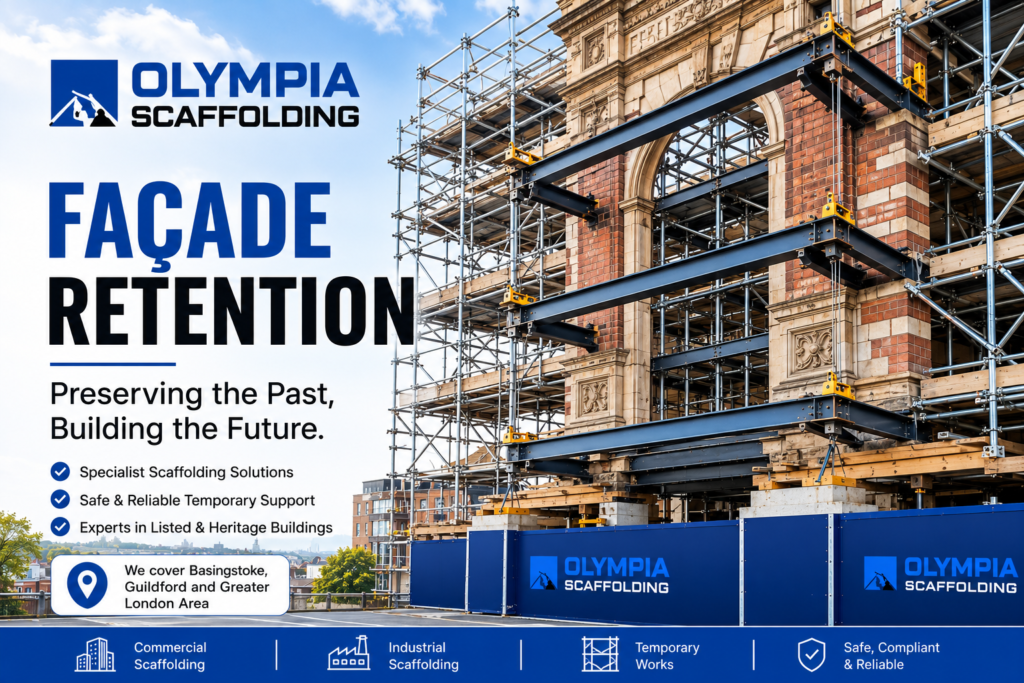
When an older or architecturally significant building needs major refurbishment, one of the biggest challenges is protecting its existing exterior while allowing extensive work to take place inside. Façade retention provides a practical solution by temporarily supporting and preserving the front or external walls of a building while its internal structure is altered, strengthened or completely reconstructed.
For commercial and industrial projects, particularly those involving listed or heritage buildings, careful planning is essential. Olympia Scaffolding provides specialist scaffolding and temporary works solutions to help contractors maintain the stability and appearance of existing façades throughout complex construction projects.
What Is Façade Retention?
Façade retention is a temporary structural support method used when the external walls of an existing building need to remain in place while other parts of the property are removed or significantly modified.
In many refurbishment projects, the original façade has architectural, historical or planning value. Demolishing it may not be permitted, or it may remove an important part of the building’s character. Instead, the façade can be carefully supported while the internal structure is renovated.
A typical project may involve:
- Carefully assessing the existing building and façade
- Designing a suitable temporary support system
- Installing scaffolding and structural support
- Removing internal sections of the building where required
- Constructing the new internal structure
- Maintaining support until the permanent structure is ready
- Safely transferring the load back to the completed building
The exact approach depends on the size, condition and design of the building, as well as the proposed construction work.
Why Is Façade Retention Important?
Many buildings in towns and cities have external elevations that contribute significantly to the local streetscape. This is particularly relevant for listed buildings and properties within conservation areas.
Using façade retention can allow developers to modernise a building without losing its original external appearance. Internally, a property may require new floors, services, layouts, structural elements and modern facilities, while the exterior remains largely unchanged.
This approach can therefore help balance conservation requirements with the practical demands of modern construction.
It can also reduce the need for complete demolition, allowing valuable architectural features to be preserved while giving the building a new lease of life.
Façade Retention for Listed Buildings
Listed buildings require particular care because alterations are often subject to strict planning and conservation requirements. Original brickwork, stonework, decorative details, windows and other architectural features may need to remain protected throughout the construction process.
A carefully engineered façade retention system can provide temporary stability while internal works progress.
Before work begins, contractors and structural professionals need to understand the condition of the existing structure. Factors such as cracks, movement, materials, previous alterations and connections between the façade and internal structure can all influence the support requirements.
For this reason, temporary works should be properly designed and installed by experienced professionals.
How Does Façade Retention Work?
Every building is different, so there is no single support arrangement suitable for every project.
A retention system may incorporate scaffolding, steel beams, structural frames, ties, props and other temporary works components. These elements are positioned to support the façade safely while construction teams work behind or around it.
The system must account for loads and environmental factors, including wind forces and the weight of the retained structure. The surrounding site conditions and available working space can also affect the design.
Installation needs to be carefully coordinated with the main contractor and structural engineer. Once the temporary system is in place, regular inspections and monitoring may be required throughout the construction programme.
The Role of Scaffolding in Façade Retention
Scaffolding is often an important part of complex façade preservation projects. It can provide safe access for workers while also working alongside temporary structural support systems.
On refurbishment projects, scaffolding may be required for:
- Inspection and assessment of the existing façade
- Brickwork and masonry repairs
- Installation of temporary supports
- Access for construction teams
- Protection of architectural features
- External maintenance and restoration
- Safe movement of materials and equipment
The scaffolding arrangement must be planned around the building and the proposed construction sequence rather than treated as a standard access installation.
Safety Considerations
Construction work around an unsupported or partially supported building façade can present significant risks. Appropriate temporary works planning is therefore essential.
A professional façade retention project should consider structural stability, site access, loading, wind exposure, neighbouring buildings and the sequence of demolition and construction activities.
Communication between the scaffolding contractor, structural engineer, principal contractor and other site professionals is particularly important. Changes to the construction programme can affect temporary support requirements, so the system should be reviewed whenever significant site conditions change.
Regular inspections can also help identify signs of movement or damage before they become more serious problems.
Benefits of Façade Retention
There are several reasons why developers may consider retaining an existing façade rather than undertaking complete demolition.
Preserves Architectural Character
Original façades can form an important part of a building’s identity. Retention allows these features to remain visible after redevelopment.
Supports Heritage Projects
For listed and historically significant buildings, retaining the existing exterior can help satisfy conservation objectives while enabling appropriate modernisation.
Enables Internal Redevelopment
The internal arrangement can be substantially redesigned to accommodate modern requirements, including new services, layouts and structural systems.
Helps Optimise Urban Development
In established town centres and urban areas, preserving existing street-facing architecture can help maintain the character of the surrounding area.
Provides a Practical Refurbishment Strategy
Where full demolition is undesirable or restricted, temporary support can create a workable route towards redevelopment.
Choosing an Experienced Scaffolding Contractor
Complex retention projects require more than conventional scaffolding knowledge. Contractors need to understand access requirements, temporary works coordination and the challenges associated with working around existing structures.
Olympia Scaffolding works with industrial and commercial clients across Basingstoke, Guildford and Greater London, providing scaffolding solutions for demanding construction and refurbishment projects.
Our team works closely with project stakeholders to develop practical access and temporary works solutions that support the construction programme while helping protect existing building features.
Planning Your Façade Retention Project
Early planning is one of the most important stages of any building retention project. Bringing the relevant specialists into the project at an early stage can help identify access requirements, structural considerations and potential site restrictions before construction begins.
If your project involves a listed building, heritage property or an existing façade that needs to remain in place during internal redevelopment, professional advice should be obtained before work starts.
Olympia Scaffolding can assist commercial and industrial clients with specialist scaffolding requirements associated with complex refurbishment and façade retention projects.
